 Image 1 of 1
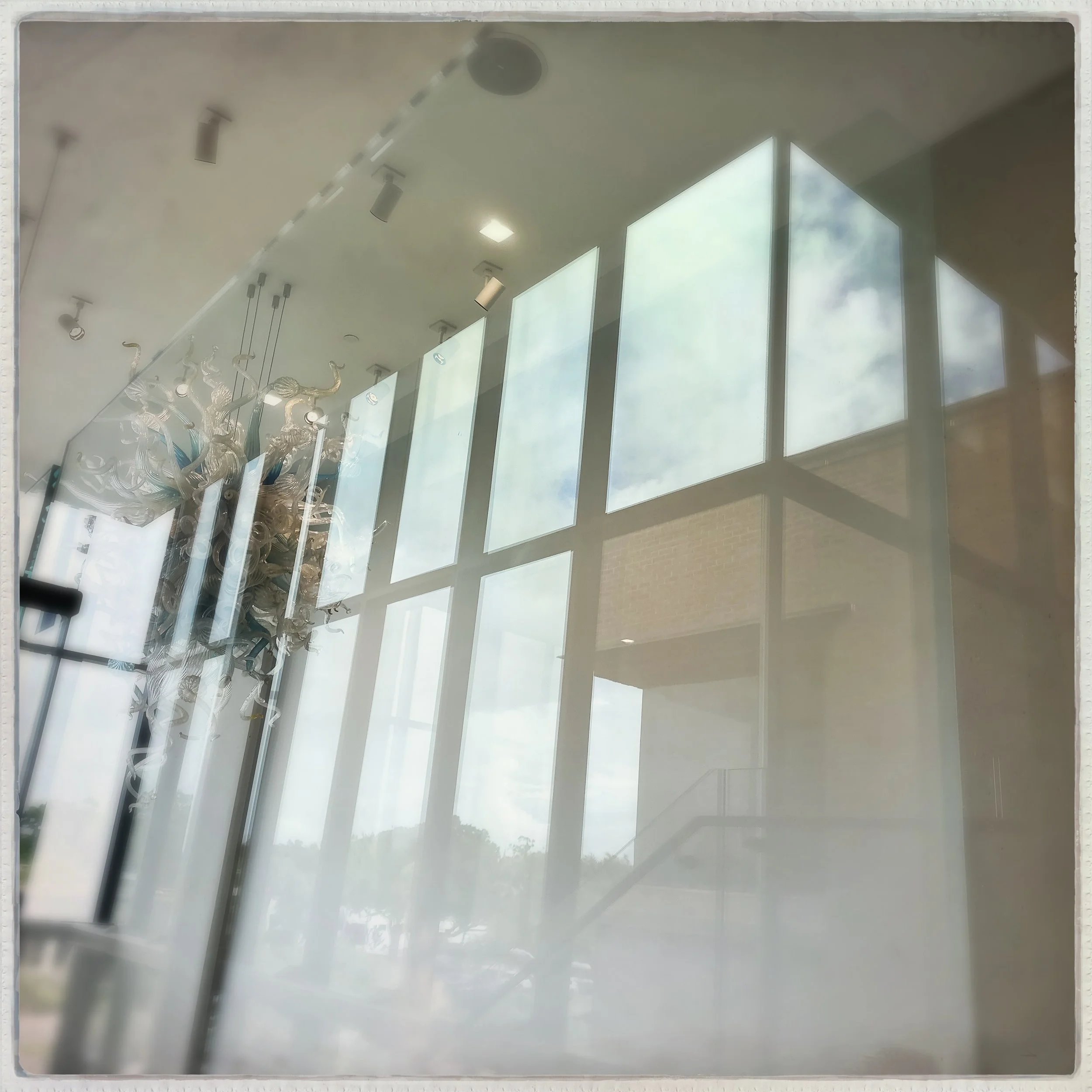
This photograph explores the delicate boundary between reality and perception through layered reflections and subtle distortion. The image captures the interior of a modern architectural space, where tall geometric windows rise toward the ceiling, their panes reflecting a pale sky drifting with soft clouds. Natural light pours through the glass, creating luminous planes that blur the distinction between inside and outside.
Superimposed within the reflective surface is the ghostly presence of an elaborate chandelier. Its twisting, glass-like forms appear suspended in midair, floating across the window panels like an apparition. Because the viewer sees the chandelier only as a reflection, its ornate structure becomes fragmented and abstract, dissolving into the surrounding architecture.
The reflective glass acts as both barrier and canvas. It merges the outside sky, interior lighting fixtures, and structural lines of the building into a single visual field. The result is a layered composition where straight architectural geometry contrasts with the fluid, organic movement of the chandelier’s curves.
A soft haze and slight blurring around the edges of the image heighten the dreamlike quality of the scene. The photograph feels suspended in a liminal moment—neither fully interior nor exterior, neither entirely clear nor completely obscured. Through reflection and distortion, the work transforms a familiar architectural space into an exploration of perception, inviting the viewer to question what is real, what is reflected, and what exists somewhere between the two.
This photograph explores the delicate boundary between reality and perception through layered reflections and subtle distortion. The image captures the interior of a modern architectural space, where tall geometric windows rise toward the ceiling, their panes reflecting a pale sky drifting with soft clouds. Natural light pours through the glass, creating luminous planes that blur the distinction between inside and outside.
Superimposed within the reflective surface is the ghostly presence of an elaborate chandelier. Its twisting, glass-like forms appear suspended in midair, floating across the window panels like an apparition. Because the viewer sees the chandelier only as a reflection, its ornate structure becomes fragmented and abstract, dissolving into the surrounding architecture.
The reflective glass acts as both barrier and canvas. It merges the outside sky, interior lighting fixtures, and structural lines of the building into a single visual field. The result is a layered composition where straight architectural geometry contrasts with the fluid, organic movement of the chandelier’s curves.
A soft haze and slight blurring around the edges of the image heighten the dreamlike quality of the scene. The photograph feels suspended in a liminal moment—neither fully interior nor exterior, neither entirely clear nor completely obscured. Through reflection and distortion, the work transforms a familiar architectural space into an exploration of perception, inviting the viewer to question what is real, what is reflected, and what exists somewhere between the two.