 Image 1 of 1
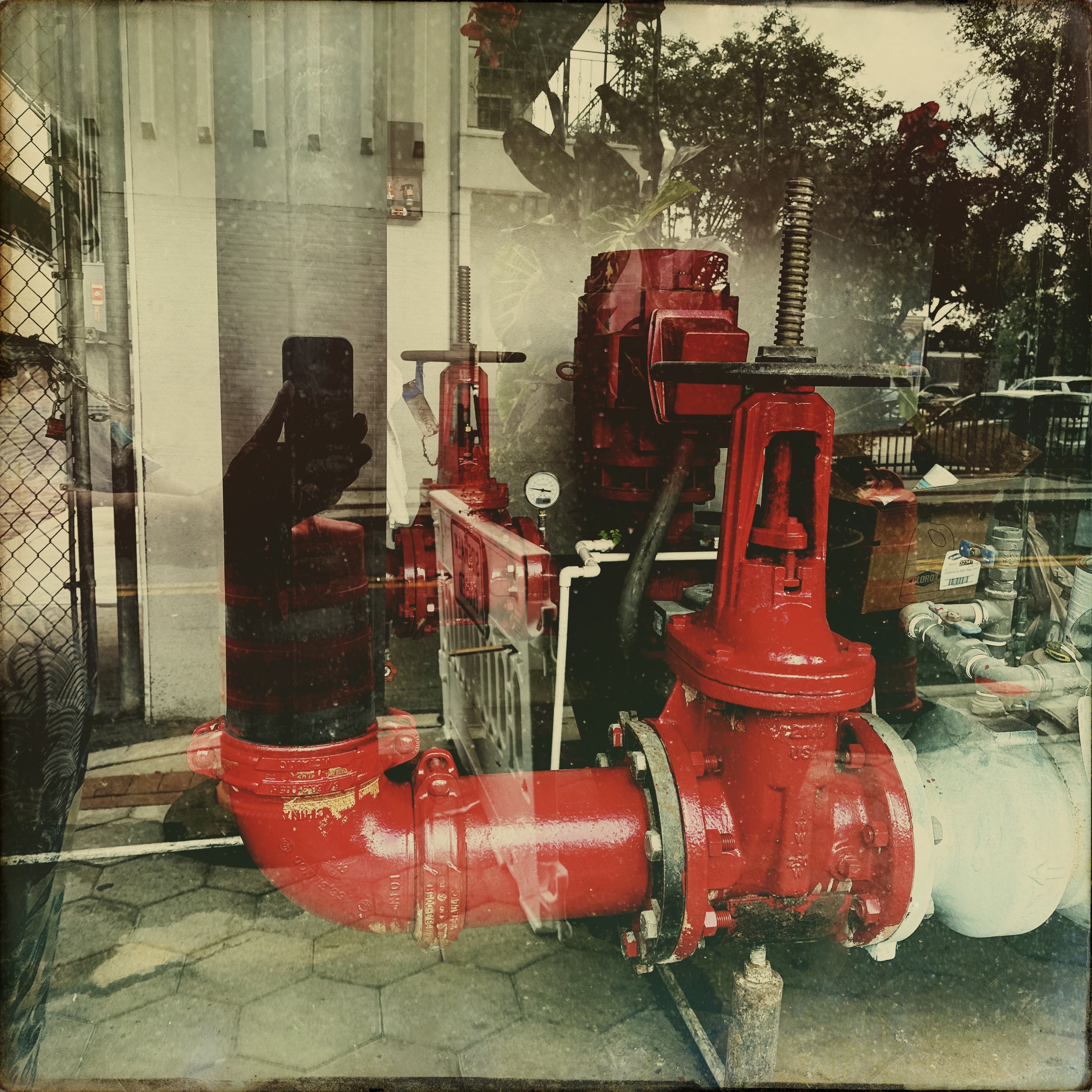
This work explores the intersection of the organic and the industrial through layered reflections captured in a pane of glass. A stand of trees and nearby buildings appear suspended on the surface of the window, their forms overlapping and dissolving into one another. The natural world—branching, irregular, and alive—meets the rigid geometry of architecture. Cutting through these reflected layers is a striking set of scarlet pipes inside the building, their bold color and mechanical precision anchoring the composition in the language of industry.
The glass becomes a threshold where multiple realities coexist. Outside, trees sway and grow according to natural rhythms; inside, pipes carry energy and resources through controlled systems designed by human hands. When these elements are compressed into a single reflective surface, distinctions between interior and exterior, natural and manufactured, begin to blur. The viewer encounters a visual dialogue between growth and construction, fluidity and structure.
The bright red pipes act as both disruption and connection. Their color asserts itself against the softer tones of leaves and sky, reminding us of the pervasive presence of human infrastructure within landscapes we often imagine as separate from it. Yet their lines also echo the branching patterns of the trees, suggesting that industrial forms may unintentionally mimic organic systems.
By layering reflections, the image invites viewers to consider how contemporary environments are rarely purely natural or purely built. Instead, they exist as complex overlays where organic life and industrial design constantly interact. The window becomes a metaphorical surface of convergence—a place where nature, architecture, and the systems that sustain modern life momentarily occupy the same visual space.
This work explores the intersection of the organic and the industrial through layered reflections captured in a pane of glass. A stand of trees and nearby buildings appear suspended on the surface of the window, their forms overlapping and dissolving into one another. The natural world—branching, irregular, and alive—meets the rigid geometry of architecture. Cutting through these reflected layers is a striking set of scarlet pipes inside the building, their bold color and mechanical precision anchoring the composition in the language of industry.
The glass becomes a threshold where multiple realities coexist. Outside, trees sway and grow according to natural rhythms; inside, pipes carry energy and resources through controlled systems designed by human hands. When these elements are compressed into a single reflective surface, distinctions between interior and exterior, natural and manufactured, begin to blur. The viewer encounters a visual dialogue between growth and construction, fluidity and structure.
The bright red pipes act as both disruption and connection. Their color asserts itself against the softer tones of leaves and sky, reminding us of the pervasive presence of human infrastructure within landscapes we often imagine as separate from it. Yet their lines also echo the branching patterns of the trees, suggesting that industrial forms may unintentionally mimic organic systems.
By layering reflections, the image invites viewers to consider how contemporary environments are rarely purely natural or purely built. Instead, they exist as complex overlays where organic life and industrial design constantly interact. The window becomes a metaphorical surface of convergence—a place where nature, architecture, and the systems that sustain modern life momentarily occupy the same visual space.